For some, it seems to be common sense that 'all models are wrong'. The phrase 'all models are wrong, but some are useful' is attributed to George Box in reference to statistical modeling (where the phrase is arguably more innocuous), though the underlying attitude is prevalent in many fields. Humility is a virtue, but the statement that all scientific models—i.e., its theories and claims about the structure of our reality—are wrong amounts to something else entirely.
Skeptical views of science can be found in many quarters. Karl Popper popularized the skeptic's view that all scientific theories are falsehoods waiting to be falsified. The view that scientific models may be gross simplifications, and can rest on falsehoods, remains the dominant outlook in orthodox economics (though it is increasingly besieged). Attacks on the concept of truth itself became common in postmodern theory, followed by some backtracking once the far right clarified the political consequences (oops, too late). It seems that to abondon the idea of truth brings one dangerously close to abandoning reason itself, and the challenge, I might venture, is to communicate what 'truth' means without falling back on any of the simplistic scarecrow definitions. The physicist David Bohm, for one, wrote very elegantly about the intinsic limitations of scienctific theories; reality is always something different from what we say it is, and always something more too, he said. But 'truth' is not a synonym for 'exact and complete description', and like Bohm one can still believe that science can (or should strive to) provide true explanations of some things.
James Franklin's An Aristotelian realist philosophy of mathematics (Palgrave Macmillon, 2014) is, as the title suggests, a defense of scientific realism for the field of mathematics. He advances the view that mathematics can establish truths about our reality. To do this, he provides a systematic response to the view that mathematics deals only in Platonic ideal-types. Because mathematics may be the most improbable bastion for realism, his argument is all the more provocative.
I find Franklin's presentation of the realist viewpoint on science to be interesting and largely compelling not despite his focus on pure mathematics (where causality and ethics are more distant concerns) but rather because his focus on mathematics allows him to isolate some essential aspects of realist philosophy.1 He's a great communicator (for his chosen audience). In this post I want to discuss one passage from Franklin's book, where he challenges Einstein's claim that mathematics is either 'not about reality' or else 'not certain'. To the contrary, Franklin argues that mathematics provides 'necessary truths about reality'.
A real, universal truth
Among Franklin's arguments is that mathematics can obtain 'necessary truths about reality'. By 'necessary' he means that the claims made by certain mathematical proofs are inescapable. By 'about reality' he means that the truth pertains to our actual reality, not to an imaginary world or to a Platonic world where mathematical ideal-types are to be found (or, actually, where they are never to be found).
Franklin is taking on Einstein's claim to the contrary:
As far as the propositions of mathematics refer to reality, they are not certain; and as far as they are certain, they do not refer to reality. (cited by Franklin, p. 67)
Franklin responds unequivocally:
Mathematics provides, however, many prima facie cases of necessities that are directly about reality.
His first example is Euler's mathematical study of the bridges of Königsberg. The locals believed that one could not possibly traverse all seven of the town's bridges without crossing at least one of them twice. As in this diagram (or model), there were two islands and seven bridges connecting two riverbanks:
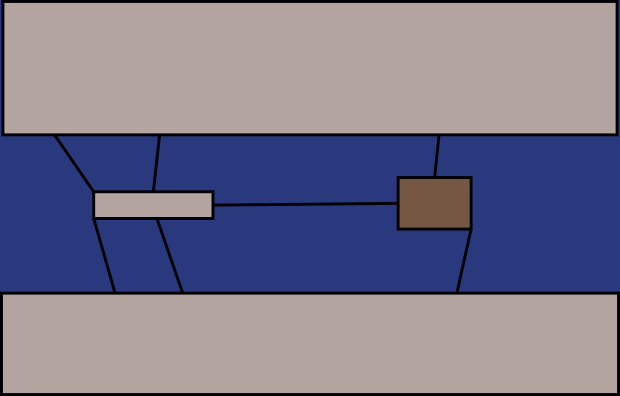
Euler's work on this problem is now a classic in operations research and network analysis (it was briefly introduced to me once in a quantitative geography course, which remains the extent of knowledge of it). Franklin describes it this way:
Euler proved that it was impossible for the citizens of Königsberg to walk exactly once over (not an abstract model of the bridges but) the actual bridges of the city. (67)
Franklin's point is that Euler's mathematical proof applies to anything that shares the abstract structure of the city's bridges and banks, which can be reduced to nodes in a network. Any truths that necessarily pertain to that structure pertain equally to any and all things that share that structure (it applies to all of its instantiations). It applies to my diagram, for example, if you wish to traverse the lines with a pen.
It is a contingency (not necessary, not guaranteed) that anything should ever have that very structure. Also, it is completely contingent that any thing that does have this structure should not quickly come to have a different structure. But it so happens that the bridges of Königsberg did have that structure, so Euler's proof applies to them.
A necessary truth, about your bathroom floor
Franklin's second example is his bathroom floor (and, presumably, your bathroom floor too). As he tells us,
It is a provable proposition of geometry that it is impossible to tile the Euclidean plane with regular pentagons. (67)
If you try, you always find gaps between the tiles. But what do Euclidean planes have to do with reality? A Euclidean plane is an idealization that is presumably not instantiated in any physical object. `If the 'Euclidean plane' is something that could have real instances', he continues, 'my bathroom floor is not one of them' (69).
But without embarrassment, Franklin states,
It is impossible to tile my bathroom floor with (equally sized) regular pentagonal lines. (67)
If you purchase square tiles, or hexagonal tiles, you can place them on a flat surface so that they align without gaps between them, covering the entire surface. If there are gaps, they can be always be made smaller by using tiles that are more straight in their edges and right in their angles. By contrast, the gaps between pentagonal tiles can never be closed except by making the tiles something besides pentagons.
So how does he transfer the necessary truth about Euclidean planes to his non-Euclidean bathroom floor? Some academics may be inclined towards skepticism of the argument so far, though a mason, I suspect, would not. But the way Franklin answers this question is valuable regardless of whether you entirely accept the bathroom floor example.
He notes that the mathematical proof has stability:
It is a further fact of mathematics, however, that the proposition of about the Euclidean plane has 'stability', in the sense that it remains true of the terms in it are varied slightly. That is, it is impossible to tile...an almost Euclidean-plane with shapes that are nearly regular pentagons. (69)
To finish the argument, he has to address an assumption that many seem to have about shapes. For some reason, squares and triangles are considered more mathematical than the shape of his bathroom floor, even though it, too has an exact shape. You might say that it is a perfect realization of its own, abstract shape.
Franklin says it this way, comparing the original geometric proof to the statement about his bathroom floor:
This [latter] proposition has the same status, as far as reality goes, as the original one, since 'being an almost Euclidean-plane' and 'being a nearly regular pentagon' are as purely abstract or mathematical as 'being an exact Euclidean plane' and 'being an exactly regular pentagon'. (69)
So if his bathroom has a shape that can be studied by mathematics, which it does, then a mathematical proof about that shape is a proof about his bathroom floor:
The proposition has the consequence that if anything, real or abstract, does have the shape of a nearly Euclidean-plane, then it cannot be tiled with nearly regular pentagons. But my bathroom floor does have, exactly, the shape of a nearly Euclidean-plane. (69)
To return this to the discussion of models, he goes on,
Or put another way, being a nearly Euclidean plane is not an abstract model of my bathroom floor, it is its literal shape. Therefore, it cannot be tiled with tiles which are, nearly or exactly, regular pentagons. (69)
And to add emphasis:
The 'cannot' in the last sentence is a necessity at once mathematical and about reality.
In this case, he uses the word model in one of the usual, colloquial ways, which is to signal difference between one's abstraction and reality; his point, though, is that this case of mathematical reasoning about abstractions (shapes) has real, necessary consequences, or 'necessary truths about reality'.
A challenge
One could argue that there is a sleight of hand behind his claim that mathematics secures truths about reality: one still needs to ascertain whether the bridges of Königsberg actually do have a given structure, and this is not itself mathematics, it is 'induction' or observational inference. Franklin might reply, 'Yes, that is so, but this kind of inference can be undertaken in a way that can remove any doubt. Typically, only an ideological skeptic would dispute the inference. This is quite obvious when it comes to pentagonal tiles and your bathroom floor, even if other problems introduce uncertainty.' Quite right, but it does mean that Franklin's argument still rests on a judgment of probability (one which is practically certain), and I suspect he may not object to that.
Although a realist philosophy of mathematics could never provide all the ingredients for a philosophy of social or natural science, I still find Franklin's ideas insightful and provocative. Franklin has already written his own book on science and truth, titled What Science Knows: And How It Knows It. I have not yet read it but I look forward to it.
Some general references
Connor Donegan (2025). 'Probability and the philosophies of science: a realist view'. SocaArXiv. PDF.
James Franklin (2014). An Aristotelian realist philosophy of mathematics. Palgrave Macmillan.
Rom Harré (1972) The Philosophies of Science. Oxford University Press.
Andrew Sayer (1981). 'Abstraction: a realist interpretation'. Radical philosophy 28: 6—15. URL
Notes
Franklin also presents part of his own argument this way. He says that we can learn a lot about logical probability through the example of mathematical problem solving because the subject matter (mathematics) is free from various complicating factors. It is especially free from contentious philosophical questions about the nature of causality.